
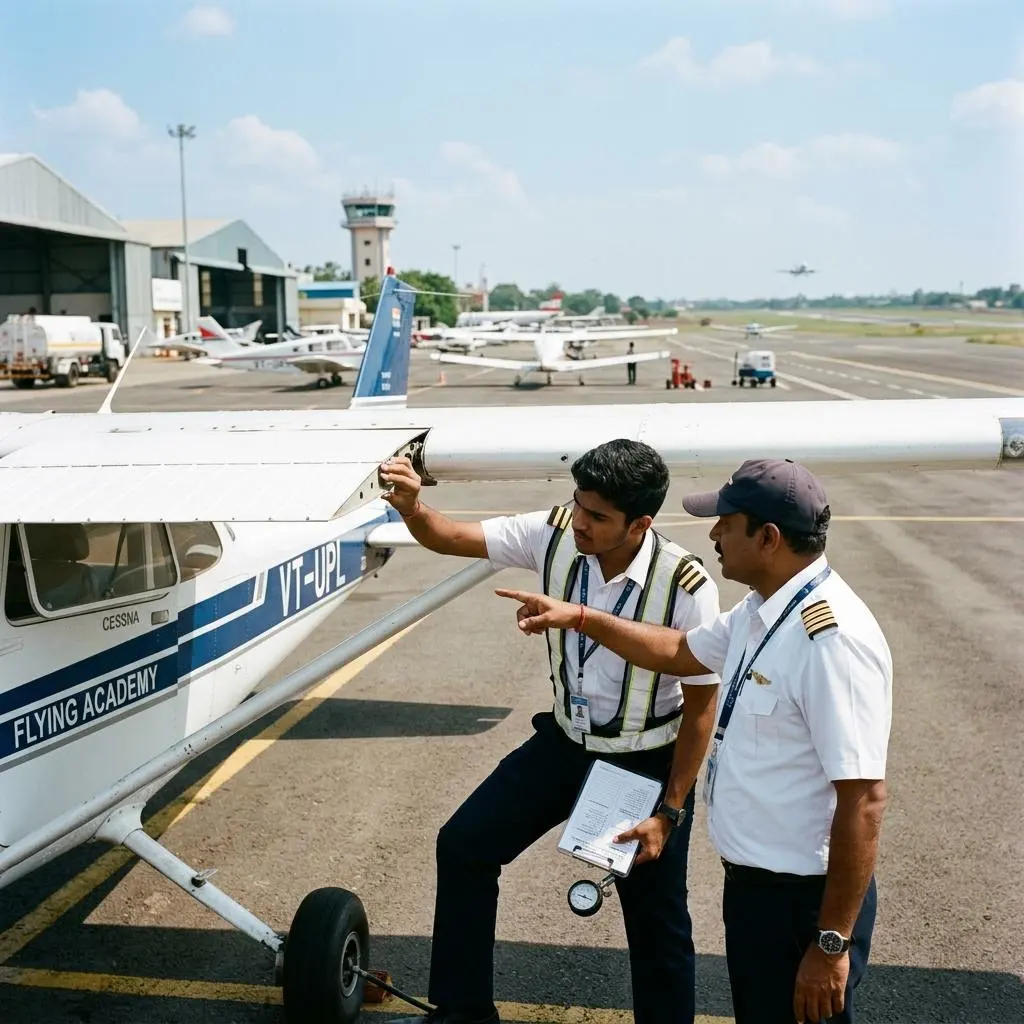
Commercial Pilot License
Structured flight training that prepares you to fly professionally. A CPL combines ground school, logged flight hours and simulator work, and is the licence most families mean when they say their child wants to become a pilot.
Eligibility, medicals and recognition
Before applying
Plan separately for overseas admission and Indian licensing. Indian aeroplane CPL eligibility includes age 18 at application and 10+2 or equivalent with Physics and Mathematics from a recognised board/university. Have academic equivalence and board-verification documents checked. An academy may impose additional English, aptitude and admission requirements.
Medical planning
Arrange advice from a DGCA-empanelled examiner before a non-refundable commitment. Confirm the Class 2 / initial Class 1 process applicable to you, resolve Indian Class 1 fitness for the professional route, and obtain the destination authority’s medical separately. Only an authorised examiner can assess vision, colour perception, hearing, health history and any limitations.
Using the qualification in India
An overseas CPL is not an Indian CPL. Use the conversion preparation checklist below and obtain an individual logbook and licensing review before choosing a course.
What the training covers
- 1
Ground school
Theory subjects such as navigation, meteorology, air law and aircraft technical knowledge.
- 2
Flight hours
Dual and solo flying, cross-country navigation and building the hours the licence requires.
- 3
Simulator and ratings
Simulator sessions plus add-on ratings such as Instrument and Multi-Engine, depending on country and academy.
- 4
Plan for Indian licensing
A foreign CPL is not permission to fly Indian-registered aircraft. Indian licensing depends on education, age, medical fitness, verified licence and logbooks, experience and recency, applicable theory and radio requirements, and DGCA-approved skill tests in India. Plan the Indian requirements before overseas enrolment; no conversion timeline or outcome is guaranteed.
Who it suits
- Students who have finished Class 12 and want aviation as a career
- Graduates switching into professional flying
- PPL holders ready to move to commercial training
How GSA Aviation helps
- Comparing the six destinations on indicative cost, duration and flying weather
- Shortlisting academies and preparing the admission file
- Student visa documentation for your chosen country
- Planning ahead for DGCA conversion requirements after training
Plan the Indian CPL conversion before training abroad
Use these preparation topics alongside DGCA’s current application requirements. The linked conversion CAR is dated 2019; check subsequent amendments, current examination notices and the requirements that apply to your licence and ratings before applying.
Establish Indian eligibility
Check Schedule II requirements for the licence sought, including age, recognised education and medical fitness. For an Indian aeroplane CPL, check the minimum age of 18 and 10+2 or equivalent with Physics and Mathematics. Obtain required academic verification and resolve equivalence before paying for training.
Match experience, not just total hours
Have a qualified adviser map your logbook to the current Indian requirements: total aeroplane time, pilot-in-command time, cross-country route and landings, instrument time and permitted simulator credit, night flying and recent experience. Overseas course minimums may differ. Identify and complete any shortfall; a foreign CPL alone does not prove compliance.
Keep the foreign licence and ratings valid
Check issuing-state licence, medical, aircraft ratings and recency. The 2019 conversion CAR defines rating currency using 10 PIC hours in the preceding 24 months (with limited dual/co-pilot credit), or an applicable flight review/check/skill test in that period in the issuing state. A non-current rating triggers additional Indian technical-specific examination, endorsement training and tests under that CAR. Confirm the current rule and its application to your aircraft.
Plan Indian medical and language requirements
Arrange the appropriate DGCA medical assessment and destination medical separately. For a professional flying route, resolve Indian Class 1 fitness early with a DGCA-empanelled examiner. Check validity, any limitations, and English language proficiency evidence required for your licence; a general English admission test is not a substitute for aviation language proficiency.
Complete applicable theory and radio requirements
The 2019 CAR specifies Air Regulations plus a CPL composite Air Navigation/Aviation Meteorology paper for foreign CPL conversion. Check current CEO/PARIKSHA notices, exam validity and your candidate category. Also confirm current radio-telephony certification, FRTO and signals/practical requirements. Do not assume that a foreign radio certificate is sufficient or that the historical WPC process still applies unchanged.
Arrange Indian skill tests and rating checks
The conversion CAR requires competency tests with a DGCA-approved examiner in India. Check the current Flight Crew Licensing Circular 01 of 2012 and any amendments for day/night, cross-country, instrument and multi-engine tests applicable to your case. Instrument and additional aircraft ratings need their own evidence and checks; they are not automatically endorsed with the CPL.
Verify records and submit the current application
Prepare identity and education evidence, valid licence and medical records, authenticated logbooks and experience summaries, theory results, radio and language evidence, skill-test reports and issuing-authority verification. Confirm the current eGCA checklist, fees, document validity and any security or authentication requirements. DGCA can verify records directly with the foreign authority and school.
Ask about Commercial Pilot License
Fill in your details and continue on WhatsApp with a counsellor.